For a child arriving from Nigeria, continuity in schooling involves the curriculum, teaching languages and stage of education. An English-language description supplies only part of that information. Public, concertado and private schools in Spain can be examined through these features before considering placement and admission.
This article concerns children’s schooling. Universities and adult Spanish-language courses are outside its scope.
Checked on 26 October 2026. The admission example concerns Madrid’s 2026/27 school year.
Language, curriculum and school ownership are different features
Spanish education law distinguishes public and private centres and allows qualifying private provision to operate through a publicly funded concierto. A concertado centre is therefore not simply a government-owned school under another name. The national framework also recognises Spanish and the other official languages in their respective territories under the applicable rules. [1]
Similarly, an international description does not identify one universal curriculum. The relevant questions concern the programme taught, the awarding body where applicable and the qualification reached at the end. A familiar language alone does not establish continuity with the child’s previous syllabus.
| Information | Question it answers |
|---|---|
| Ownership and funding | Who operates the centre, and which provision is publicly funded? |
| Curriculum and qualification | What is studied, and what award is reached? |
| Teaching languages | Which language is used for each subject and stage? |
| Support arrangements | What assistance is available for this child’s transition? |
Where compulsory schooling begins and ends
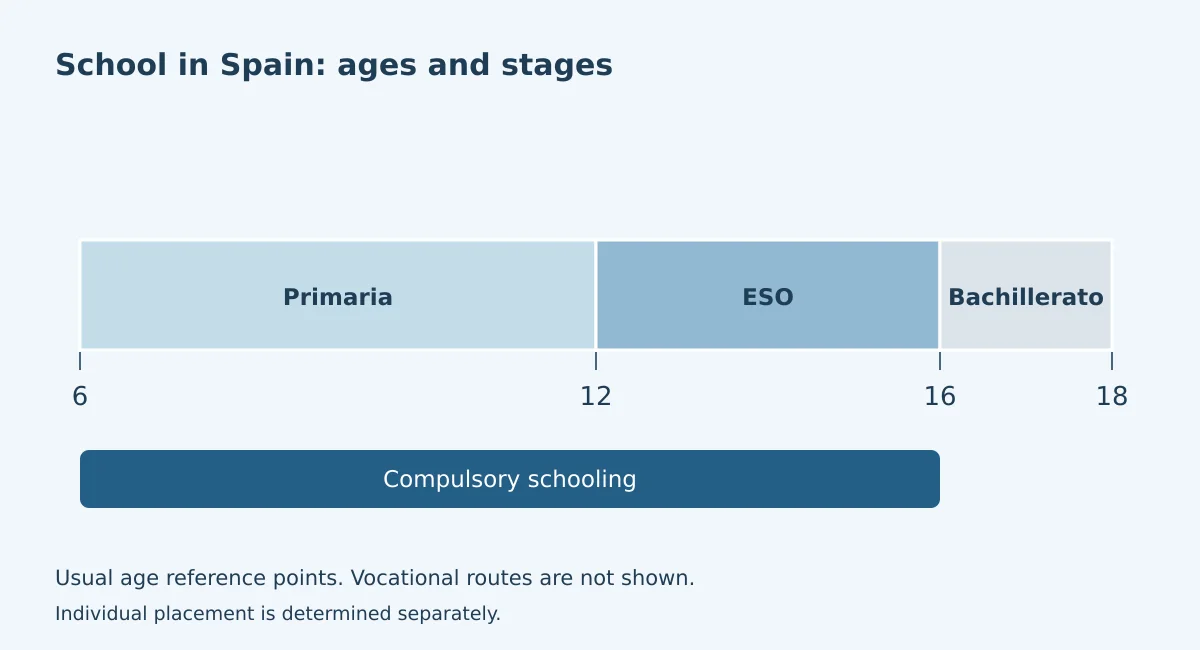
Eurydice describes six years of Educación Primaria, normally from ages 6 to 12, followed by Educación Secundaria Obligatoria, or ESO, normally from 12 to 16. These form ten years of free compulsory schooling. Bachillerato is a subsequent two-year stage, usually from 16 to 18, rather than another name for the whole compulsory secondary stage. [2]
The age ranges are ordinary system reference points, not an individual placement decision. Matching a Nigerian class number to a Spanish class number without considering the educational stage can obscure whether the child is entering compulsory schooling or a later course with a different access basis.
Joining from abroad: placement and language support
Articles 78–79 of the Education Law address late entry through age, knowledge and academic history. They also provide for specific programmes where significant language or basic-learning gaps arise, alongside attendance in ordinary groups. The content of support depends on the pupil’s needs. [4]
What a fee or a school photograph cannot show

A tuition quotation does not necessarily describe the total amount spent on a school day. Meals, transport, materials and additional activities are distinct items whose inclusion needs to be clear in the centre’s own information. No national price range is used here to imply that all schools offer the same package.
These distinctions do not produce a ranking of public, concertado and private schools. Ownership and price alone cannot settle the separate questions of curriculum continuity, language demands and individual support.
Admission information is regional and school-year specific
Madrid’s published 2026/27 extraordinary-admission arrangements refer to available places and the relevant Schooling Support Service, Servicio de Apoyo a la Escolarización. This is one autonomous community’s example, not a nationwide timetable or a guarantee of a place at a preferred centre. [5]
A submitted application, a place allocation and completed enrolment describe different stages. An article about one region’s process cannot establish another region’s dates or filing channel. The same caution applies to information from a previous school year.
The site’s Spain residence overview covers the family’s immigration basis separately. Its discussion of country-comparison criteria explains the wider household context. A child’s school place does not, by itself, define the residence position of the whole family.
Questions and answers
Does entry to Primaria or ESO require recognition of previous Nigerian school years?
Madrid’s Education Inspectorate states that pupils entering any Primaria or ESO year from a foreign system do not need convalidación or homologación of earlier schooling for that entry. Recognition of a completed foreign qualification equivalent to ESO or Bachillerato is a separate procedure. The school-place process still applies. [3]
Does “bilingual” mean every subject is taught in English?
The label alone does not identify the language of each subject. English taught as a subject and English used to teach mathematics describe different arrangements. Spanish education law recognises Spanish and the other official languages under the applicable territorial rules; a school’s programme provides the subject-level detail. [1]
Sources
- Spain: Organic Education Law 2/2006, current consolidated text
- Eurydice Spain: organisation of education, updated 20 January 2026
- Government Delegation in Madrid: Education Inspectorate, foreign schooling
- Spain: Education Law, articles 78–79, late entry and support
- Comunidad de Madrid: 2026/27 school admission