
Spain’s household expenditure survey includes both money spent and some non-cash consumption. This matters when a yearly national average appears beside a monthly rental offer. The sections below explain the survey categories before examining single-person figures, transport and household payments.
The distinction matters because Spain’s official household-expenditure survey includes some consumption that does not involve a corresponding cash payment. An annual average is informative, but it is not a ready-made monthly budget for a new tenant.
Checked on 26 October 2026. INE expenditure statistics concern 2025; the transport example concerns 2026.
An official average is not an amount everyone needs
INE’s 2025 Household Budget Survey reported average annual expenditure of €35,101 per household and €14,066 per person, published on 25 June 2026. These are consumption-survey measures, not minimum-income requirements. [1]
Dividing €14,066 by twelve gives approximately €1,172.17 a month. That arithmetic changes the time unit; it does not change the underlying measure. It cannot establish the actual cash expenses of a single person renting a separate home.
INE’s methodology includes monetary expenditure and certain non-monetary consumption. Imputed rent is one of the latter categories. It represents housing consumption rather than a second payment that an owner necessarily makes. [2]
The rent an owner does not transfer to a landlord
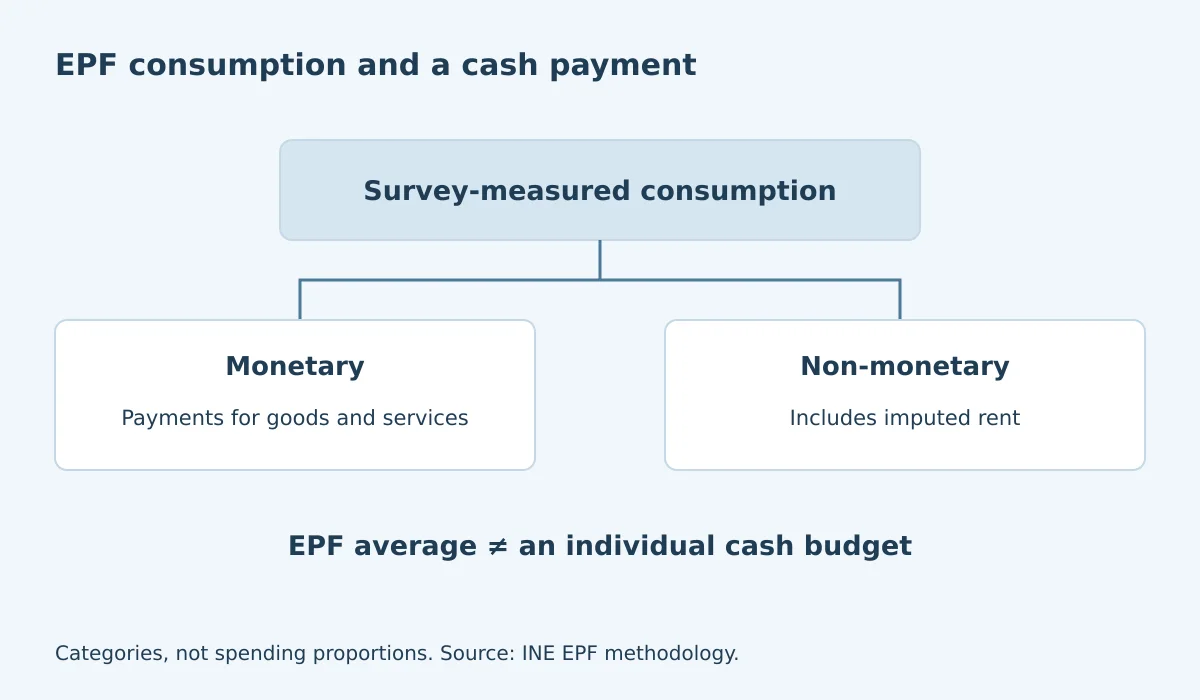
A couple sharing a home also cannot be described by multiplying every expense for one independently renting person by two. Some payments are shared and others individual. The relevant household arrangement needs to be defined before the comparison has a consistent unit.
Single-person households and food expenditure
Food and non-alcoholic drinks averaged €5,626 annually per household, or about €468.83 monthly. That denominator is a household, not a single adult; it is expenditure rather than the price of a fixed basket. [1]
A transport price that identifies its area and passenger group
Madrid’s CRTM published 2026 discounted ordinary-pass prices of €32.70 for zone A, €38.20 for B1 and €43.20 for B2 for the 26–64 age group. The stated subsidies run until 31 December 2026. This is a Madrid-system example rather than a national Spanish transport price. [4]
The personal transport card has its own documentation requirements. CRTM’s current FAQ lists identity evidence and an empadronamiento certificate or record. A published pass price therefore does not establish that an applicant already meets the card-issue requirements. [5]
Travel beyond a pass’s scope, taxis and private-car use are different costs. A familiar monthly fare does not describe the time needed for a journey or prove that the same product serves two different home addresses.
What utility and grocery amounts need to identify

The Spanish consumer ministry explains that an electricity bill identifies the billing period, contracted power, meter readings, energy consumed, prices, taxes and other applicable items. A quoted bill without its period or consumption cannot establish one nationwide monthly electricity cost. [6]
For food, the measurement might be a pack, a kilogram or a whole shopping trip. Two receipts can differ because of quantities rather than prices. A dated retail example and a monthly household basket therefore answer different questions.
Neither a grocery illustration nor a few item prices establishes the diet or shopping frequency of a particular household. Meals out and food prepared at home also have different contents. A basket comparison needs quantities and a shopping period.
Starting a household and paying for an ordinary month
Furniture, initial connections and a housing deposit can affect money needed at the start. They do not all recur each month, and refundable security differs from payment for consumption. A combined total without periods can conceal those differences.
The same separation applies to money held in Nigeria. A euro charge and its naira funding cost are linked through the exchange rate, transfer charges and timing. A fixed conversion would make a changing funding condition look like a permanent Spanish price.
Household size, tenure and included services explain the variation behind these Spanish cost figures. The Spain overview covers immigration conditions; the country-comparison article considers other aspects of day-to-day life.
Questions and answers
Does the €1,982 monthly figure describe a single person’s cash budget?
It is €23,784 divided by twelve: INE’s 2025 observation for a one-person household under 65. The survey includes non-cash consumption. Dividing by twelve changes the time unit, not its contents, so the result is not a quoted budget for someone taking a new rental home. [1]
Can advertised rent simply be added to the full survey total?
First, the housing component already in the statistic needs to be identified. INE includes imputed rent: an estimated housing-consumption value rather than necessarily a cash payment. Adding a complete advertised rent without separating the original components can mix two different housing measures. [3]