A German rental listing can show a basic rent, additional running costs and a deposit together. Reading the German terms reveals which amount recurs and which secures the tenancy. The example below follows those payments, then turns to the home’s description and the handover record.
For readers comparing German housing while living in Nigeria, the German terms explain the structure more precisely than a single converted price. This article concerns residential tenancies, not holiday booking rates or a catalogue of available properties.
Checked on 26 October 2026. The numerical example is fictional, not a market quotation.
How much is rent in Germany? The payment and its contents
The official Make it in Germany portal distinguishes basic rent, Kaltmiete, from Warmmiete, which includes the agreed operating charges. Examples of such charges include water, heating and building services. The actual agreement determines the contents; the word Warmmiete does not establish that internet and every individual utility contract are included. [1]
In a fictional example, Kaltmiete is €800 and an operating-cost advance is €200. The regular payment to the landlord is €1,000. A separate electricity contract would be another item if it is not included. The example illustrates categories, not the price of an apartment in any particular German city.
A search for average rent in Germany needs a defined dataset. For example, Berlin’s Mietspiegel 2026, published on 28 May 2026, reports an overall median net basic rent of €7.71 per square metre in the covered data. This local survey measure is neither a nationwide average nor a current available-apartment quotation. Multiplication by a hypothetical floor area would not establish a real offer. [2]
Why an advance can lead to a later adjustment
The €200 in the example is an advance. A later statement concerns the actual accounting under that arrangement, rather than a second rent for the same month. Conversely, an agreement using a lump sum should not automatically be described as if it had the same advance-payment structure.
From Nigeria, a euro payment and the naira amount required to fund a transfer are also separate measurements. Exchange rate, charges and timing affect the latter. No fixed naira conversion is used as though it were a permanent German housing price.
The deposit is separate from the monthly housing payment
Section 551 BGB limits the agreed security for ordinary residential tenancies to three months’ rent excluding separately stated operating costs. [4]
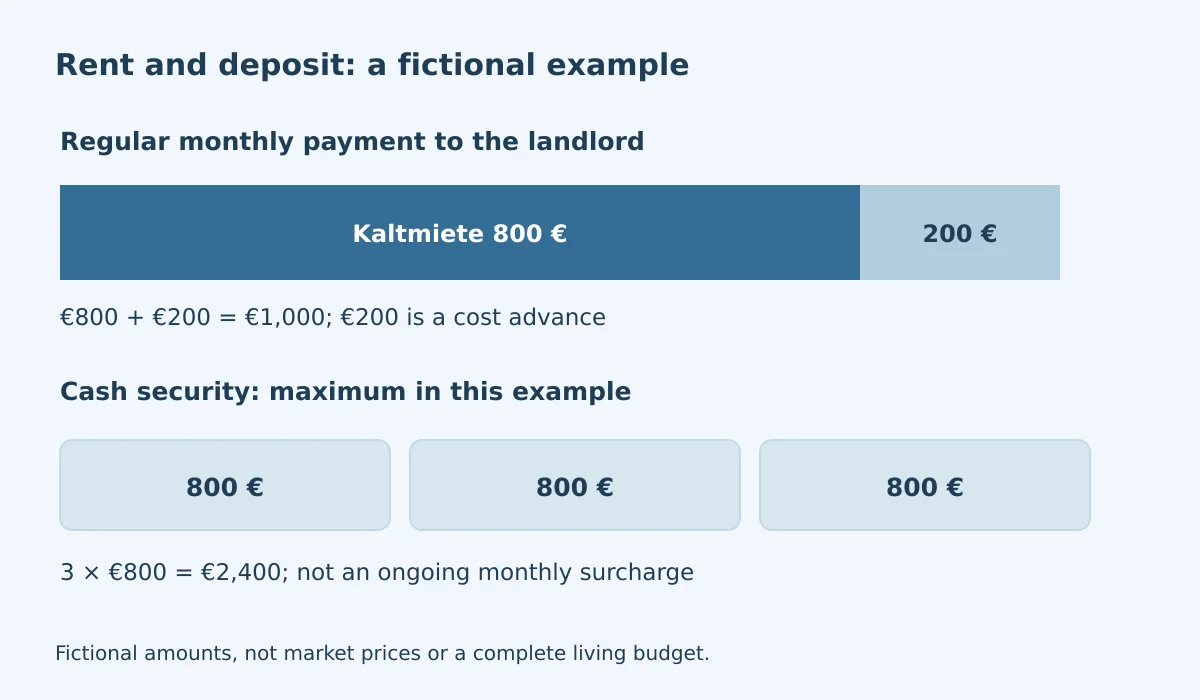
With €800 basic rent, the corresponding maximum in the example is €2,400. It is not €3,000 calculated from the €1,000 combined monthly payment. Three €800 deposit instalments also do not replace the regular rent.
A deposit is security for obligations, not a pre-priced final period of occupation. Neither its amount nor a description of three instalments establishes that it will be returned on the exact day the keys are handed back. This example does not decide an individual deposit dispute.
House rent, a flatshare room and the number of bedrooms
The official housing portal distinguishes a rental flat, a furnished short let, a WG flatshare and student accommodation. A regular rental flat may lack furniture or an equipped kitchen. A flatshare room gives access to shared facilities and describes a different housing arrangement from a self-contained flat. [1]
In a German listing, a 2-Zimmer-Wohnung usually has two living rooms in total, for example a bedroom and a sitting room, alongside a kitchen area and bathroom. The label does not necessarily mean two bedrooms. This vocabulary matters when comparing house rent in Germany with the type of home a reader has in mind. [1]
With the fictional maximum deposit above, the initial €800 instalment plus €1,000 regular rent produces a first payment of €1,800 to the landlord. Separately contracted services, moving and furniture remain outside it. The calculation shows the timing of payments under the stated terms, not a typical national move-in price.
From an offer to the condition recorded at handover
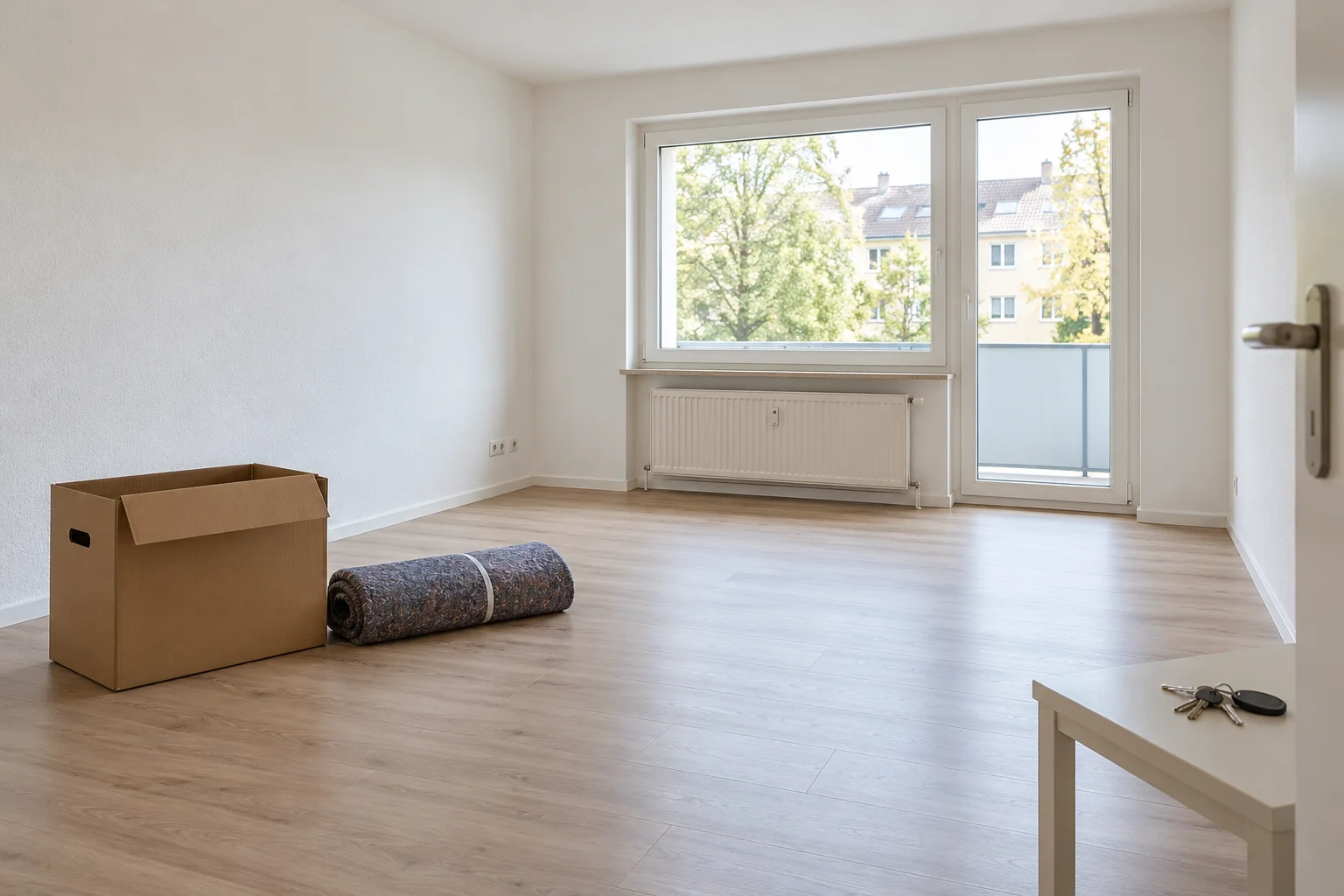
The documents have distinct roles. Furnishing and the kitchen must refer to the actual home rather than an illustrative photograph.
- Advertisement: describes the offered home.
- Agreement: identifies the tenancy terms.
- Handover record: documents the property’s condition.
Make it in Germany describes the Übergabeprotokoll, recording the condition of a property at handover. Existing damage and meter readings are relevant to documenting that starting point. The record performs a different task from evidence that money has been paid. [1]
For example, a dated photograph of a marked floor can document appearance at entry. It does not establish the value of later repairs or prove that a deposit was transferred. Keeping the roles of documents distinct avoids reading more into an attachment than it shows.
Remote correspondence and false listings
German police describe false rental advertisements using other people’s photographs and requests for money before a viewing, sometimes explained as a payment to send keys from abroad. A platform logo or an identity-document image does not by itself establish control of the property. These are published risk patterns, not a finding about any particular listing. [5]
The distinction is especially relevant when the entire conversation occurs remotely. A convincing description and a genuine-looking photograph establish neither availability nor the sender’s authority. A finding about a particular advertiser would require evidence about that offer and sender.
The agreement records housing obligations. Residence conditions are described in the Germany overview, while the country-comparison article places housing alongside other household considerations.
Questions and answers
Must the entire cash deposit be paid in one transfer?
Section 551 BGB provides a right to three equal monthly instalments where the security is money. The first is due when the tenancy begins; the remaining instalments accompany the immediately following rent payments. The deposit payments do not replace ordinary rent. [4]
Can operating costs be adjusted after monthly advances have been paid?
Section 556 BGB distinguishes a lump sum from an advance. Advances are accounted for annually, so the monthly amount is not the final statement of actual costs for the period. A later balance relates to that accounting; it should not be confused with a second payment for the same already settled obligation. [3]