
The minimum wage in Germany is quoted per hour, whereas salary statistics commonly describe a month of full-time employment. The calculations below put the hourly rate into a stated monthly example before turning to medians, occupational groups and payroll deductions.
Checked on 26 October 2026. Earnings statistics concern 2025; the current statutory minimum concerns 2026.
From an hourly minimum to a monthly illustration
The minimum-wage adjustment regulation sets €13.90 gross per hour from 1 January 2026 and €14.60 from 1 January 2027. The latter is a future rate at the checking date, rather than the current October 2026 rate. [1]
Under an illustrative assumption of 40 hours a week, annualised across 52 weeks and divided by 12, the calculation is €13.90 × 40 × 52 ÷ 12 = €2,409.33 gross per month. The hours and averaging method are stated assumptions. This calculation is not a second statutory rate and does not establish the amount due in an individual’s payroll.
Average salary in Germany per month: the year and population
| Measure | Published amount | Scope |
|---|---|---|
| Destatis arithmetic mean | €4,851 gross monthly | Full-time employees, 2025, excluding special payments [3] |
| BA median | €4,217 gross monthly | Covered full-time employees subject to social insurance, 2025 [4] |
The average salary in Germany shown here is not a 2026 starting offer. The statistical year is 2025 even though the information is available in 2026. The two rows also come from different statistical systems: their difference cannot be attributed solely to the distinction between mean and median.
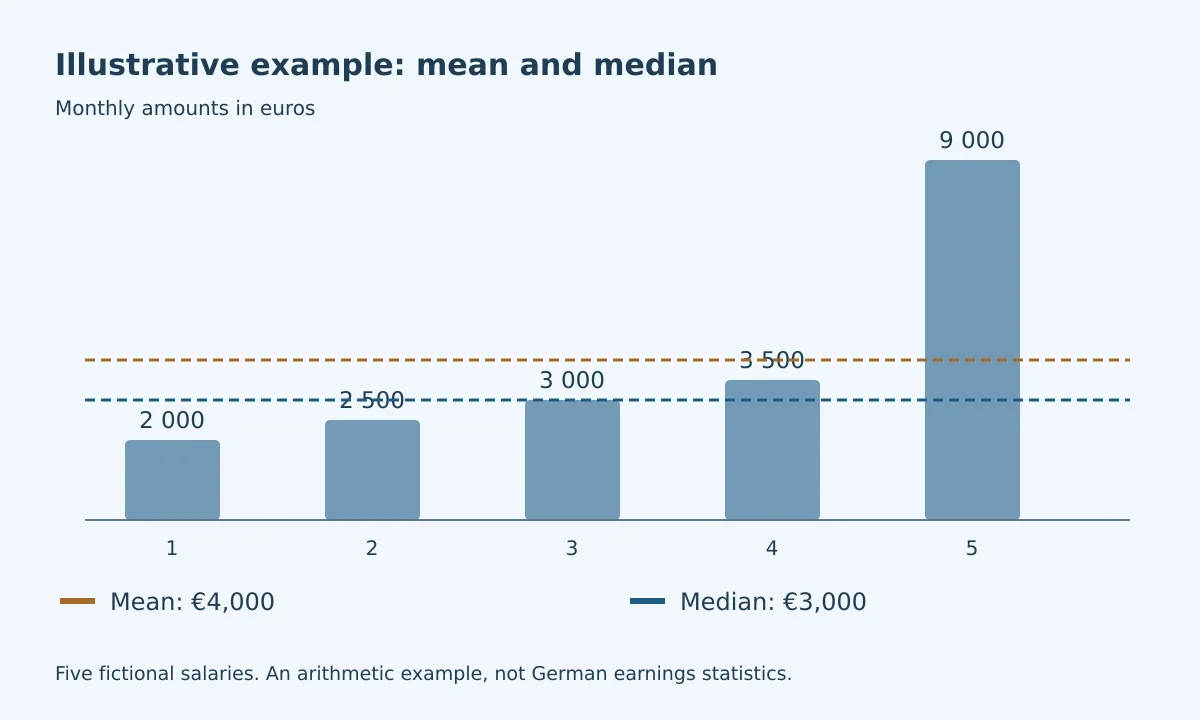
In a fictional five-person example, earnings of €2,000, €2,500, €3,000, €3,500 and €9,000 produce a €4,000 arithmetic mean and a €3,000 median. This is an explanatory calculation, not German earnings data. The high observation raises the mean without becoming the middle observation.
Occupations, experience and the missing comparison

The Federal Employment Agency’s Entgeltatlas reports professional aggregates, rather than a guaranteed amount for each individual job title. Its help page describes the core population of full-time employees covered by social insurance and excludes categories such as vocational trainees. Occupation-group assignments can also change over time. [5]
The following official-card examples use the same measure: Germany-wide median monthly gross earnings for full-time work, all ages and sexes, at the Fachkraft requirement level. They describe occupational groups rather than individual offers.
| Occupational group | Monthly gross median |
|---|---|
| Motor-vehicle technology, skilled work | €3,755 [6] |
| General nursing without specialisation, skilled work | €4,587 [7] |
| Software development, skilled work | €4,612 [8] |
In the nursing card, “Ausbildung” identifies the occupational qualification route; the earnings figure describes employed professionals, not a training allowance. Software development at Fachkraft level is also a different category from the Experte group. These distinctions prevent unlike roles from being presented as one universal salary.
Geography adds another dimension. BA’s 2025 publication gives workplace-based medians of €4,768 in Hamburg and €3,497 in Mecklenburg-Western Pomerania. These are group results, not a quantified pay rise that any worker receives by moving between the two locations. [4]
Gross pay is not a fixed take-home percentage
Gross pay precedes the relevant deductions. Net pay follows the individual payroll calculation. A nationwide average cannot supply a universal deduction percentage, and a monthly net amount does not yet describe the household’s money remaining after rent and other spending.
For a reader funding commitments in Nigeria, a euro salary and the naira value of a later transfer are different measures. The conversion depends on the rate, charges and timing. Neither the nominal conversion nor the gross salary establishes how much remains available after personal expenses.
Work and residence conditions are covered in the Germany overview. Connections with more than one tax system are examined in the article on tax residence when relocating; salary medians alone do not establish that status.
Questions and answers
When is salary paid in Germany?
The agreed payment terms identify the payday; there is no single payday established by the earnings statistics. For the statutory minimum-wage component, BMAS states payment is due at the agreed time and no later than the last bank working day of the following month. Limited exceptions apply to qualifying written working-time accounts. This minimum-wage deadline is not a universal payday for every salary component. [10]
Does being a foreign worker change the statutory minimum-wage rule?
BMAS states that the minimum wage also applies to foreign workers working in Germany, whether the employer is German or foreign. Vocational training, certain internships and other specified situations have separate treatment. A person’s nationality alone therefore does not establish a lower minimum or settle how a training arrangement is classified. [2]
Will the BMF wage-tax calculator give my take-home pay?
BMF explicitly says its wage-tax calculator is not a complete gross-to-net service. It does not calculate individual net income after the applicable social contributions. Subtracting only the displayed tax amount would leave those other deductions unresolved. [9]
Sources
- German legislation: MiLoV5, section 1
- BMAS: minimum-wage questions and answers
- Destatis: development of gross earnings, 2025, excluding special payments
- Bundesagentur für Arbeit: 2025 full-time earnings, release 20 July 2026
- Bundesagentur für Arbeit: Entgeltatlas methodology
- Entgeltatlas: motor-vehicle technology, Fachkraft
- Entgeltatlas: general nursing, Fachkraft
- Entgeltatlas: software development, Fachkraft
- Federal Finance Ministry: scope of wage-tax calculator
- BMAS — Statutory minimum wage: entitlement and payment due