Public schools in Germany follow education rules set by the federal states, so a family arriving from Nigeria encounters a local school process within a national outline. Primary-school stages provide the starting point. Berlin’s allocation procedure and examples of care and lunch show how attendance is organised in practice.
German public schooling is the subject here. An international private-school prospectus or university admission page describes a different educational setting.
Checked on 26 October 2026. Berlin and Hamburg arrangements below are local examples, not procedures for every German state.
Who sets the rules, and what public education covers
The official Make it in Germany portal states that education policy belongs to the federal states. Most schools are state-run and provide free education. Organisation, curricula and teaching materials can differ between states; the portal directs readers to state and school information for local arrangements. [1]
Free tuition describes the teaching charge. It does not identify every possible expense connected with a school day. Equally, the existence of optional services does not establish a uniform mandatory charge for every family. A cost needs its own description, period and applicable conditions.
Publicly funded, English-taught and international are different characteristics. One does not establish another. For a child whose previous schooling used English, the relevant language environment and support need to refer to the actual German programme.
Primary school in Germany: four years or six
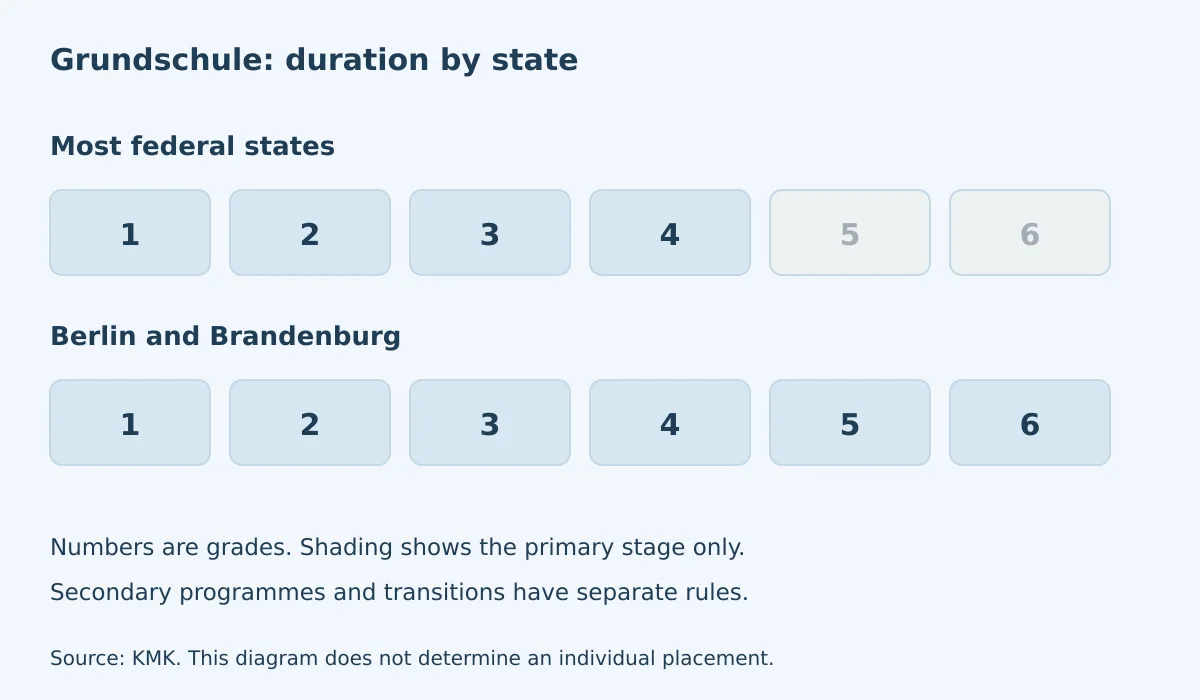
KMK describes primary school, Grundschule, as grades 1–4 in most states and grades 1–6 in Berlin and Brandenburg. Secondary tracks are organised through differing school types; a school can combine more than one track. General compulsory full-time schooling normally starts in the year a child turns six and lasts nine or ten years, depending on state and programme. [2]
The number of years already completed abroad is part of an educational record. It does not by itself establish a particular German school placement. A previous grade label can be read alongside subjects, results and the circumstances of the transfer.
A diagram of the stages therefore describes the system rather than a placement decision for an individual child. It also does not establish that every school with a familiar translated name offers identical programmes or leaving qualifications.
A Berlin example: allocation comes before registration at the school
Berlin’s family portal describes district coordination offices for welcome classes, Willkommensklassen. The office assesses German-language knowledge, considers age and identifies the school. Registration then takes place at that school. Identity papers, registration information and school reports are among the documents mentioned where available. [3]
This is a specific local process. It is not a nationwide checklist for children arriving from Nigeria, nor does it set the application dates used by every education authority. The responsible office and the school perform different tasks in the sequence described.
Language support is not a statement about ability in every subject
The Berlin welcome-class arrangement concerns German-language learning and entry into regular learning. Its language assessment belongs to the local placement process. A child’s passport alone does not describe their German proficiency. [3]
Understanding a mathematical idea and understanding a question written in another language are different tasks. A school record can document earlier subject achievement, while a language assessment addresses another part of the child’s learning situation. One result should not be read as a complete account of the other.
The description also needs to distinguish the support available from the support actually assigned. A school website can identify a programme; an individual decision establishes how a child participates. No particular level of fluency or time to transition is promised here.
What time do German schools start and finish?
Hamburg describes lessons in its GBS model as running from 08:00 to 13:00, with partner-provided care in the afternoon. Berlin lists a reliably provided 08:00–16:00 day for its compulsory all-day primary-school model, gebundene Ganztagsgrundschule. These describe different arrangements, not one national timetable. [4] [5]
The day after lessons: care and lunch
A family may encounter these documents even when the services occupy the same building.
- School-place confirmation: records the place.
- Weekly timetable: shows the organisation of lessons.
- Catering or care agreement: sets the relevant service arrangements.
A school name and a qualification answer different questions
A programme’s name identifies a course of education. Its leaving qualification describes an outcome reached under the relevant requirements. The mere availability of a programme does not establish that a particular pupil has already acquired its certificate.
A place allocation, daily timetable and leaving qualification each record a particular part of schooling. For the family’s position outside school, see the Germany overview and the country-comparison article.
Questions and answers
Is a catering contract needed for Berlin’s free primary-school lunch?
Berlin states that pupils in grades 1–6 are entitled to lunch without parental cost participation. To use that offer, a contract is concluded with the school’s caterer. This is a Berlin arrangement; free provision and administrative enrolment are separate matters. [6]
Does a previous school report establish a place at a Berlin school?
The report records prior learning. Berlin’s welcome-class procedure uses the district coordination office to identify the school and class; registration then takes place at the assigned school. An educational record, a place allocation and completed registration therefore have different roles. [3]
Does an all-day school mean lessons continue throughout the care period?
A stated attendance period can include teaching, activities and supervision. The class timetable and care arrangements identify their respective hours. The local examples in the article do not establish uninterrupted lessons or one common finishing time for every German school. [5]
Sources
- Make it in Germany: School system and compulsory education
- KMK: Educational paths and qualifications
- Berliner Familienportal: Willkommensklassen in Berlin
- Hamburg school authority: Ganztagsangebot, GBS and GTS models
- Berlin Senate: Ganztagsschulen, school-day arrangements
- Berlin Senate: Grundschule, school lunches