
With assumed contributory earnings of €3,000, a stated health-insurance rate can be traced through the total contribution and the employee’s share. That calculation comes first below. Eligibility, family cover, private premiums and patient copayments then explain the other amounts a reader may encounter.
This article concerns residents’ insurance arrangements. A policy bought for a temporary journey has its own scope and does not, through its title alone, establish membership of a German statutory fund.
Checked on 26 October 2026. Contribution figures and thresholds refer to 2026.
How much is health insurance in Germany? An employment example
The Federal Health Ministry publishes a general statutory health-insurance rate of 14.6% of contributory income, plus the particular fund’s additional rate. Ordinary employee contributions from earnings are shared equally with the employer, including the additional component. The monthly contribution ceiling is €5,812.50. [1]
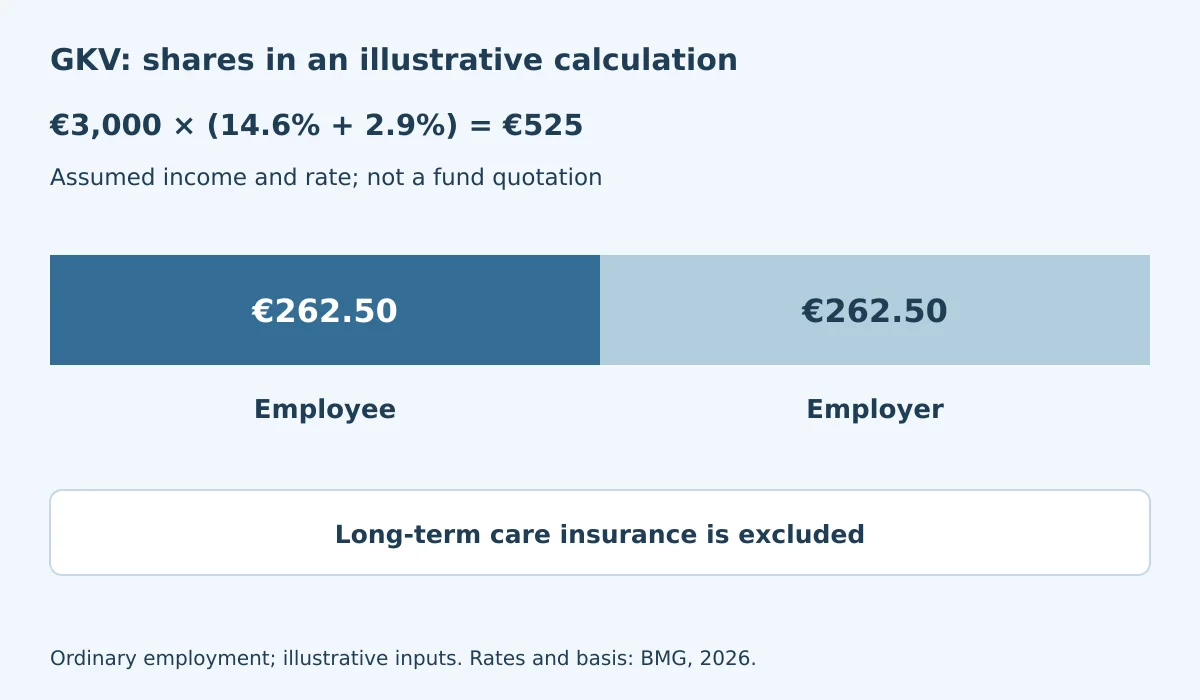
| Illustrative input or result | Amount |
|---|---|
| Contributory monthly earnings | €3,000 |
| Assumed rate | 14.6% + 2.9% = 17.5% |
| Total contribution | €525 |
| Employee share | €262.50 |
| Employer share | €262.50 |
The additional rate is assumed for this example, not a named fund’s quotation. Pflegeversicherung and other payroll deductions remain outside the calculation.
Reading €525 as an employee-only deduction would double the employee share in this example. Reading €262.50 as the whole contribution would omit the employer share. Neither figure is a complete payroll calculation: other deductions have their own rules.
Membership is a separate question from the calculation
Germany’s statutory system, GKV, has compulsory, voluntary and family membership arrangements. The ministry identifies earnings and employment conditions among the factors relevant to ordinary employees. In 2026 the general annual earnings threshold for the relevant compulsory-insurance category is €77,400; rules about timing and expected earnings also matter. [2]
For a person living in Nigeria, a proposed German job and an insurance start date need their own documentary basis. Nigerian nationality alone does not determine the contribution or prove that a particular German membership arrangement has begun. A quotation, an application and confirmation of cover can refer to different stages.
Family cover depends on each relative’s circumstances
The ministry describes contribution-free statutory family cover for qualifying children, spouses and registered partners. Conditions include residence, income and the relative’s own insurance position. A relationship alone therefore does not establish eligibility. [2]
A household calculation has to distinguish a member’s contribution from the insurance position of other people. Multiplying one premium by the number of family members can misstate the arrangement. Assuming every relative has automatic free cover can do the same. The relevant confirmation needs to identify the person and applicable cover.
What a private premium measures

In private health insurance, PKV, the ministry explains that entry age, assessed risk and agreed benefits affect the premium. The usual reimbursement model involves the patient paying a provider’s invoice and submitting it to the insurer. Special provisions apply to arrangements such as the basic tariff. [3]
A lower monthly figure does not describe the same contract with a smaller price unless the insured benefits and payment obligations also match. An excess, reimbursement terms and the services included affect what the policy means in a particular case. This comparison of concepts does not assign a preferred system to a reader.
An invoice and a reimbursement decision also have different roles. The first records a provider’s charge. The second establishes the insurer’s response under the arrangement. Keeping them distinct is relevant to cash flow as well as the eventual amount borne by the patient.
Copayments and evidence of insurance
A Zuzahlung is a service-related copayment. For applicable medicines, the ministry describes 10% of the dispensing price, normally at least €5 and at most €10, never more than the medicine’s price. Exemptions and exceptions apply. It is not a uniform charge for every prescription or every insured person. [4]
For funding from Nigeria, conversion and transfer charges sit alongside the insurer’s euro amount. Residence information is in the Germany overview; other household considerations appear in the country-comparison article.
Questions and answers
Are the compulsory-insurance threshold and contribution ceiling the same?
No. The annual earnings threshold concerns the insurance position of the relevant employee category. The contribution ceiling limits earnings used in calculating contributions. They serve different functions; exceeding one is not a substitute for establishing the conditions associated with the other. [1] [2]
Does the announced average additional rate fix every fund’s charge?
The ministry explains that the additional rate is set by each fund and can differ from the announced average. The article’s 2.9% input is an assumption for the example, not a quotation from every fund. The actual fund rate is part of the contribution calculation. [1]
What does a German electronic health card establish?
Under section 291a SGB V, the eGK provides evidence of entitlement in contracted medical care and supports billing. It is not a blanket confirmation that every privately offered service is included. The scope of the particular benefit still matters. [5]