
Sharing a flat changes how dwelling-level bills are divided. A broadcasting contribution and an assumed internet bill illustrate the arithmetic below, followed by official single-person expenditure observations, transport prices and the boundary between payroll deductions and household spending.
The examples below combine published household observations with separately identified tariffs and illustrative arithmetic. They do not reproduce the detailed subjects of rental deposits, payroll calculation or health-insurance eligibility.
Checked on 26 October 2026. The household survey is EVS 2023; transport and broadcasting prices are identified separately.
A shared bill does not necessarily double with headcount
The official Beitragsservice states the ordinary broadcasting contribution, Rundfunkbeitrag, as €18.36 monthly per dwelling, regardless of the number of residents. Exceptions and particular arrangements can apply. It is neither a separate charge for each flatmate nor a home-internet subscription. [1]
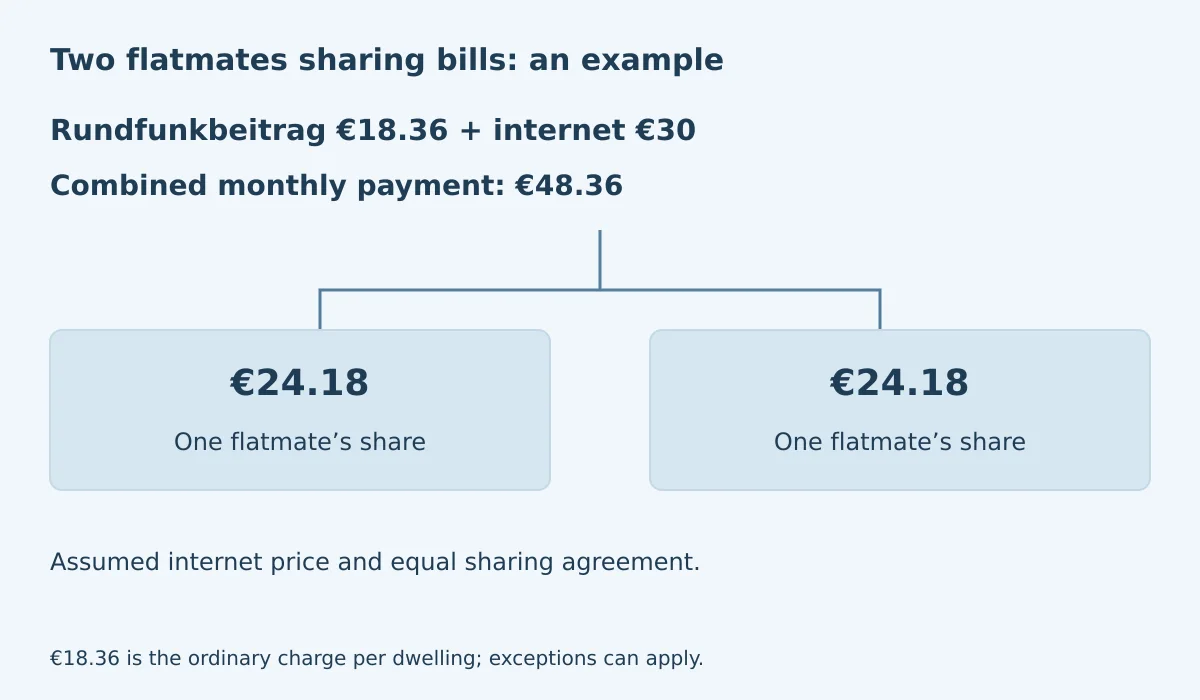
Fictional equal-sharing calculation:
- Ordinary dwelling-level broadcasting contribution: €18.36.
- Assumed internet bill: €30.
- Combined two-item payment: €48.36.
- Equal share for each of two flatmates: €24.18.
Only the ordinary broadcasting amount is taken from the published tariff; internet and equal division are assumptions.
An independently occupying person could bear those dwelling-level charges alone. Food and personal travel follow a different pattern. The example therefore does not establish that every expense falls by half when two people share a home.
Monthly expenses in Germany for a single person
Destatis’s EVS 2023 main programme reports mean monthly consumption expenditure of €3,032 across households, €1,918 for one-person households and €3,382 for two-person households. These are survey observations, not a 2026 minimum-income requirement. [2]
| EVS 2023 household group | Mean monthly consumption |
|---|---|
| All households | €3,032 |
| One person | €1,918 |
| Two people | €3,382 |
The one-person observation describes consumption in the survey year. An actual single-person monthly account instead identifies the person’s rent and included services, independently paid utilities, travel and purchases. It can be compared with the survey only after those boundaries and the dates are clear. The average cost of living in Germany is therefore context for that account, rather than a list of invoices assigned to every adult.
The groups differ in more than headcount. Their housing and circumstances also vary. Subtracting the one-person mean from the two-person mean would not isolate the cost of adding a second adult to a particular flat.
Destatis also publishes a separate LWR series for 2024. It uses a different survey and period. The figures in the table above deliberately remain within EVS 2023 rather than being assembled from unlike observations into an apparent personal budget. [3]
What the current transport subscription includes
Deutsche Bahn lists the Deutschlandticket at €63 a month through 31 December 2026. It is a subscription for local and regional public transport, not ordinary ICE or IC/EC travel. Its page announces €66.80 from 1 January 2027. [4]
A November 2026 calculation and a 2027 calculation therefore need different stated dates. Travel outside the product’s scope also remains separate. A familiar pass price does not establish the cost of every trip, a private car or a long-distance journey.
Electricity expenditure is not a supplier’s current quotation

The Destatis EVS 2023 energy table reports mean electricity expenditure of €93 monthly across all households and €63 for one-person households. These concern 2023, not a guaranteed bill or supplier tariff for 2026. [5]
An individual agreement has consumption, fixed components and a billing period. A current advance payment describes a payment schedule and need not equal the final energy cost attributed to that period. A later adjustment can concern earlier consumption.
For example, two debits in one month might relate to a current advance and a previous year’s reconciliation. Their combined cash amount is real for that month, but it is not evidence of two identical current monthly bills. Dates and purposes preserve the distinction.
Living expenses and amounts already deducted from pay
Gross earnings, the amount available after deductions and consumption expenditure are separate measures. Comparing an expense total with earnings therefore needs to identify which earnings figure is being used. This article does not assign a fixed percentage of salary to every household.
Food, starting costs and funding from Nigeria
A few food prices cannot establish a monthly diet without quantities, household size and a shopping period. The household survey does not specify a dated shopping basket for this household. Furniture and refundable housing security can also affect money needed initially without becoming recurring monthly consumption.
The naira needed to fund a euro payment depends on conversion and transfer charges. Immigration information is in the Germany overview, with other day-to-day considerations discussed in the country-comparison article.
Questions and answers
Does one broadcasting contribution always cover an entire student residence?
Beitragsservice distinguishes a room opening onto a generally accessible corridor from rooms forming a shared flat behind a separate apartment door. The former can count as an individual dwelling; the latter is treated as a shared dwelling. The accommodation label alone therefore does not settle the contribution unit. Exemption conditions are a separate issue. [1]
Should insurance already withheld from pay be deducted again from net income?
A budget starting with the amount received after payroll deductions should not subtract the same withheld contribution as another bank payment. Independently paid cover has a different payment pattern. This distinguishes cash movements; it does not calculate insurance eligibility or personal tax.