
A Milan transport pass has a published price and a defined validity period. It makes a useful starting point for separating a payment from a monthly equivalent. Italy’s household expenditure data, housing bills and grocery receipts use other measures, which are set out in the following sections.
For readers in Nigeria, there is another distinction: the Italian charge is stated in euros, while the naira needed to fund it depends on the exchange rate and transfer conditions. Converting an unclear total does not resolve what that total contains.
Checked on 26 October 2026. Istat figures concern 2025 and were published on 8 October 2026. The ATM tariff was checked during preparation.
A Milan pass: the price and the payment period
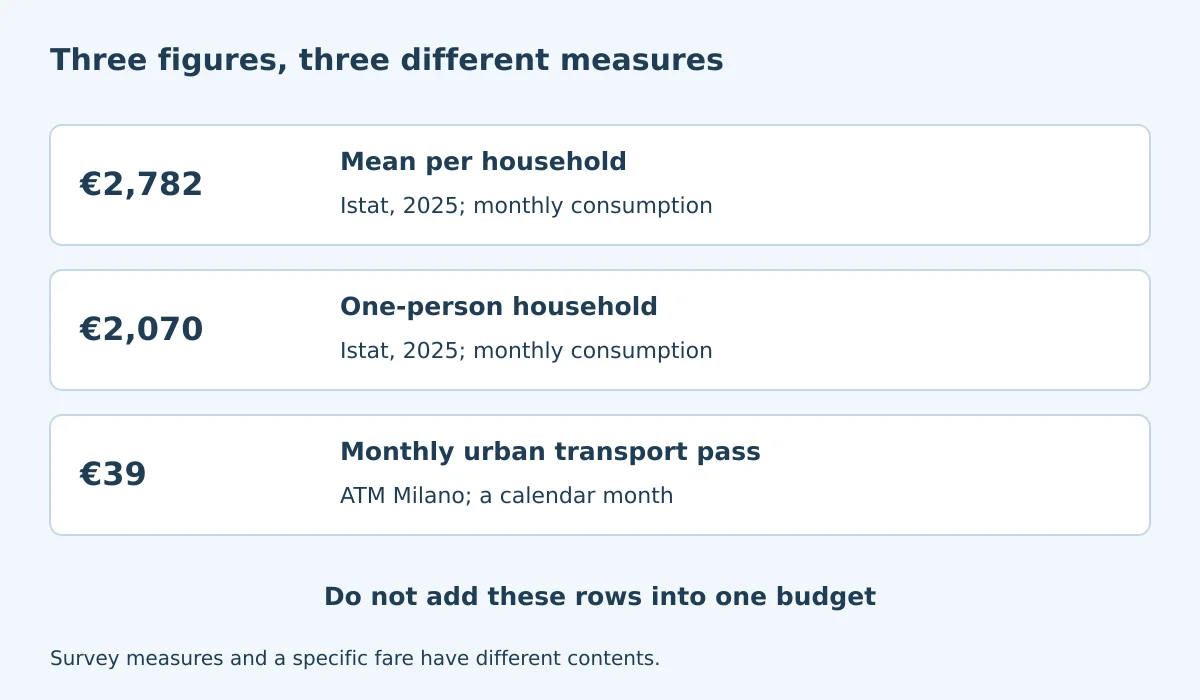
ATM lists its ordinary Milan urban monthly pass at €39 and the annual pass at €330. The monthly product runs from the first to the last day of the calendar month. These are Milan products, not national Italian transport charges. [1]
What Istat measures across households
| 2025 measure | Euros per month |
|---|---|
| Mean household consumption expenditure | 2,782 |
| Median household consumption expenditure | 2,338 |
| Mean for a one-person household | 2,070 |
| Food and non-alcoholic drinks, mean per household | 552 |
The source is Istat’s household-expenditure survey. Its rental-paying households reported mean rent of €438 monthly. That measure is not a current asking-rent average for new contracts in a particular city. [2]
The table’s rows are overlapping indicators, not separate items to add. The first two describe the distribution of overall household consumption. The third concerns a household category. The food row identifies part of expenditure, with the household as its denominator.
Cost of living in Italy for a single person
Living alone, sharing a flat and being one member of a larger household are different arrangements. A household average divided by a headcount cannot establish the price of occupying a separate home. Some costs belong to the dwelling and others respond more directly to the number of people.
For example, two people sharing one internet contract would not normally create two identical charges merely because there are two users. Buying twice as much of a product has a different relationship to headcount. This explains why a single multiplier cannot reproduce every expense in a household.
Istat’s consumption survey also includes imputed rent and own-produced consumption. Its total is therefore broader than cash paid out from a bank account. A cash budget needs its own record of actual payments and what each includes. [3]
Housing and energy need an explicit boundary
In a fictional example, a €120 bill covering two months represents €60 a month by division. The calculation is valid for those inputs but says nothing about a typical Italian bill. A comparison also needs the period, consumption and charging structure. The example is not a quotation for a particular apartment.
| Personal payment category | Information that defines it |
|---|---|
| Housing | Room or whole home, agreed rent and included services |
| Electricity | Billing period, consumption and fixed components |
| Food | Household size, quantities and shopping period |
| Transport | Specific product, territory and validity |
Groceries, a shopping basket and the first month

A food budget describes purchases over a stated period. Four fictional €50 receipts total €200, but they do not show whether the purchases supply every meal for a calendar month. Food obtained elsewhere and meals eaten out would need their own treatment. A product-price comparison instead requires matched goods, quantities and observation dates.
No dated retail basket is claimed here. The accompanying image illustrates groceries and does not establish either their prices or a complete diet. National household food expenditure also answers a different question from the price of a fixed basket for one adult.
A move-in month can additionally contain a deposit, furniture or connection charges. Refundable security and consumed services have different meanings, even when both require money at the start. Separating them preserves the distinction between cash needed initially and a recurring month’s spending.
For a Nigerian-funded budget, the euro payment and the naira needed to make it depend on the conversion date and charges. Residence information is in the Italy overview; the country-comparison article considers the surrounding household context.
Questions and answers
Is €27.50 a separate monthly Milan travel pass?
It is €330 divided by twelve, expressing the annual pass price in monthly units. ATM separately lists the ordinary urban monthly product at €39. The operator also identifies an instalment option for the annual pass through a Telepass arrangement; its terms are distinct from the arithmetic monthly equivalent. [1]
Can an electricity bill include charges when no energy was used?
ARERA’s quota fissa includes time-based charges and a component linked to contracted power, due even without consumption. A per-kWh price therefore does not describe the entire bill. Comparing two bills also needs the billing period and contracted power. [4]