
The cost of living in France involves payments with different periods: weekly grocery spending and an annual contract need different conversions to a monthly equivalent. Beginning with two fictional calculations, this article then examines housing in the Paris agglomeration, rental charges, the Navigo fare and household contracts.
For readers in Nigeria, the relevant starting point is a euro expense with a defined period and contents. The naira needed to fund it is affected separately by exchange rates and payment conditions. This article concerns everyday expenditure rather than tuition or an immigration income threshold.
Checked on 26 October 2026. The OLAP rent observation concerns early 2025; the Navigo tariff concerns 2026.
Weekly purchases and the calendar of payments
Suppose a fictional household spends €60 on groceries every week. Across 52 weeks that is €3,120, equivalent to about €260 monthly in a model using 52 weeks and twelve months. Multiplying by four instead produces €240 and represents four weeks, not the same annual calculation. The assumed purchase amount is not an observed French shopping basket.
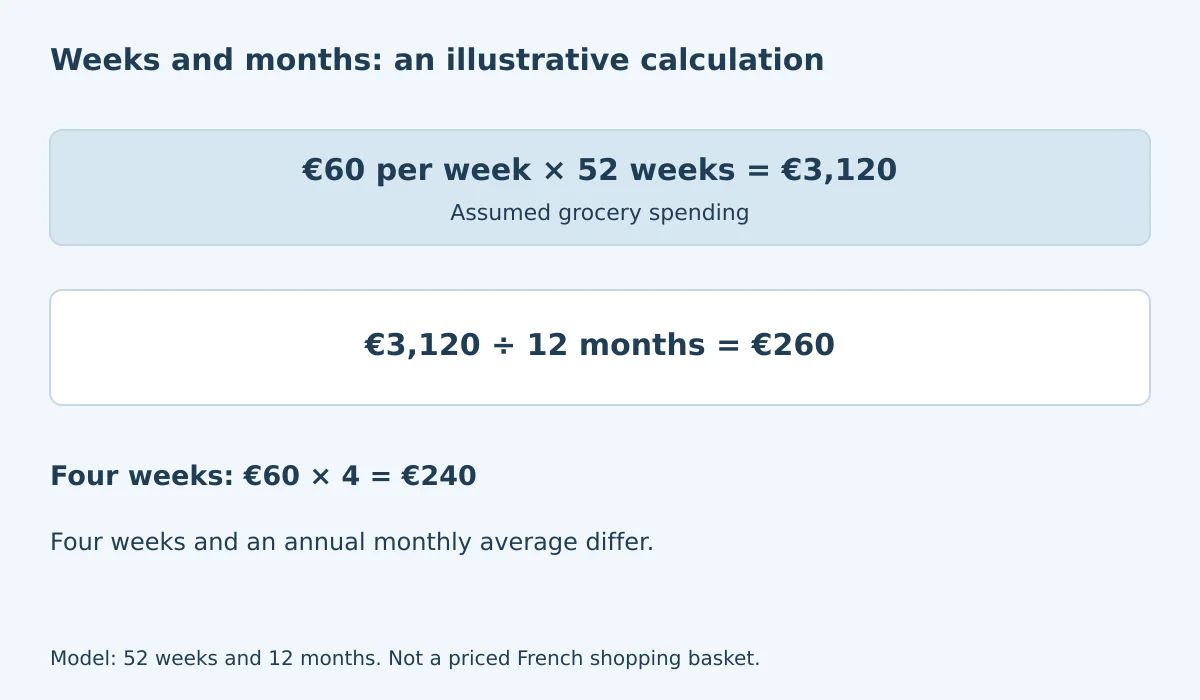
Receipts for an actual calendar month provide another measure: what was bought within those dates. That amount can differ from an annual monthly allocation. Neither is inherently a mistake, but the period needs to be stated for the numbers to be compared.
Similarly, an assumed €120 annual contract has a €10 monthly equivalent. Its payment date still follows the contract. An allocation across twelve months does not create twelve equal debits. This distinction is especially visible in a move-in month containing several first payments.
Housing data for the Paris agglomeration
OLAP’s August 2025 report describes the surveyed private unfurnished rental stock in the Paris agglomeration. At the start of 2025 its mean rent excluding charges was €1,070 monthly, for a mean area of 53 m², or €20.3 per m². This is neither a France-wide figure nor a quotation for an available flat. [1]
The geographical scope includes more than Paris itself. The dwelling type and exclusion of charges also matter. Applying the number to a furnished home elsewhere would substitute a different housing arrangement for the one observed.
Multiplying a statistical per-square-metre figure by a desired floor area does not establish an actual offer. The property has its own address, features and agreed terms. A survey measure can provide context without identifying the rent or legal treatment of a particular contract.
Additional charges and separately paid services
Service Public describes recoverable rental charges as expenses initially paid by the landlord and reimbursed by the tenant. Payment arrangements depend on the tenancy. Advances and lump sums have different conditions; advances are subsequently reconciled with expenses under the applicable arrangement. [2]
In a fictional example, €800 basic rent and a €100 charge advance produce a current €900 payment. A separate electricity contract remains another item if it is outside those charges. The figures illustrate the categories and are not a market estimate for a French city.
Identifying included services prevents the same expense being counted twice. It also makes a later adjustment distinguishable from another month’s basic rent. The word charges alone cannot establish that every household service has already been paid.
Navigo: a published fare and a conditional reimbursement
Île-de-France Mobilités lists the 2026 all-zone 1–5 Navigo Mois at €90.80. It is a particular monthly transport product, not the transport expenditure of every resident of France. [3]
For qualifying private-sector commuting subscriptions, Service Public explains the general employer reimbursement of 50%, subject to the applicable conditions. Single tickets are outside that arrangement. [4]
Electricity and the separate home-insurance contract

The national energy ombudsman’s information service, Energie-Info, distinguishes the fixed subscription part of an energy bill from the variable consumption part. A price per kWh alone therefore does not describe the whole charge. [5]
The figures above retain their own periods and geographical scope. The France overview describes residence conditions; the country-comparison article considers aspects of living abroad beyond these household payments.
Questions and answers
Is €45.40 the Navigo fare available to every passenger?
The stated fare is €90.80; €45.40 is the remainder when exactly half is reimbursed. Service Public describes reimbursement of qualifying commuting subscriptions for private-sector employees, with conditions and particular part-time rules. Single tickets are outside that subscription scheme. An after-reimbursement expense is different from the public product price. [4]
Does home insurance replace medical insurance in the household budget?
The residential rental obligation described by Service Public concerns at least fire, water-damage and explosion risks. It does not establish medical cover. The existence of the obligation also does not specify one premium for every home; the contract has its own price and terms. [6]
Sources
- OLAP: Évolution en 2024 des loyers, Paris agglomeration; August 2025
- Service Public: Charges à payer par le locataire
- Île-de-France Mobilités: transport tariffs 2026
- Service Public: private-sector commuting reimbursement
- Energie-Info: fixed and variable components of electricity and gas prices
- Service Public: tenant home-insurance obligation